Published by BlueCollarHousing.com — Hotel alternatives for those working on the road
You know the drill. The job comes through, you pack your truck, and two days later you're checking into a hotel somewhere you've never been, hoping the Wi-Fi works and the guy in the next room doesn't watch TV until 2 AM.
For a night or two, it's fine. For six months, it will grind you down.
Industrial workers — welders, pipefitters, boilermakers, electricians, ironworkers and the rest of the trades that keep America's refineries, pipelines and plants running — have been dealing with this reality for decades. Long assignments, hotel after hotel, spending half their per diem just to have a place to sleep.
That's starting to change.
The Hotel Problem Nobody Talks About
Hotels are designed for travelers who stay two or three nights. A business traveler passing through. A family on vacation. Someone attending a conference.
They are not designed for a pipefitter who just signed on for a six month turnaround and needs somewhere to cook a real meal, do laundry without paying $4 per item, and actually decompress after a twelve hour shift.
The problems stack up fast:
Cost. A decent hotel in an industrial corridor runs $80 to $150 per night. That's $2,400 to $4,500 per month — often more than what a furnished rental costs for the same period. Workers burning through their per diem on hotel bills have less money in their pocket at the end of the job. That's real money lost.
No kitchen. Eating out every meal gets old fast and gets expensive even faster. A furnished rental with a real kitchen means you control what you eat, when you eat, and how much you spend. After a long shift, being able to crack open a beer and cook your own food is not a luxury — it's sanity.
Noise. Hotels are transient by nature. The person next door changes every few nights. Some nights it's quiet. Some nights it's not. When you're working twelve hour days six days a week, bad sleep is not just annoying — it affects your safety and your performance on the job.
No space. A standard hotel room is roughly 300 square feet. For one night that's fine. For six months it's a cell. Nowhere to spread out, nowhere to store your gear, nowhere to feel like a human being at the end of the day.
Security. Hotel parking lots are not secure. Workers often have thousands of dollars of tools and equipment in their trucks. Theft is a real problem — and it happens more than people talk about.
What a Furnished Rental Actually Looks Like
When workers find a good furnished rental near a job site, the difference is immediate.
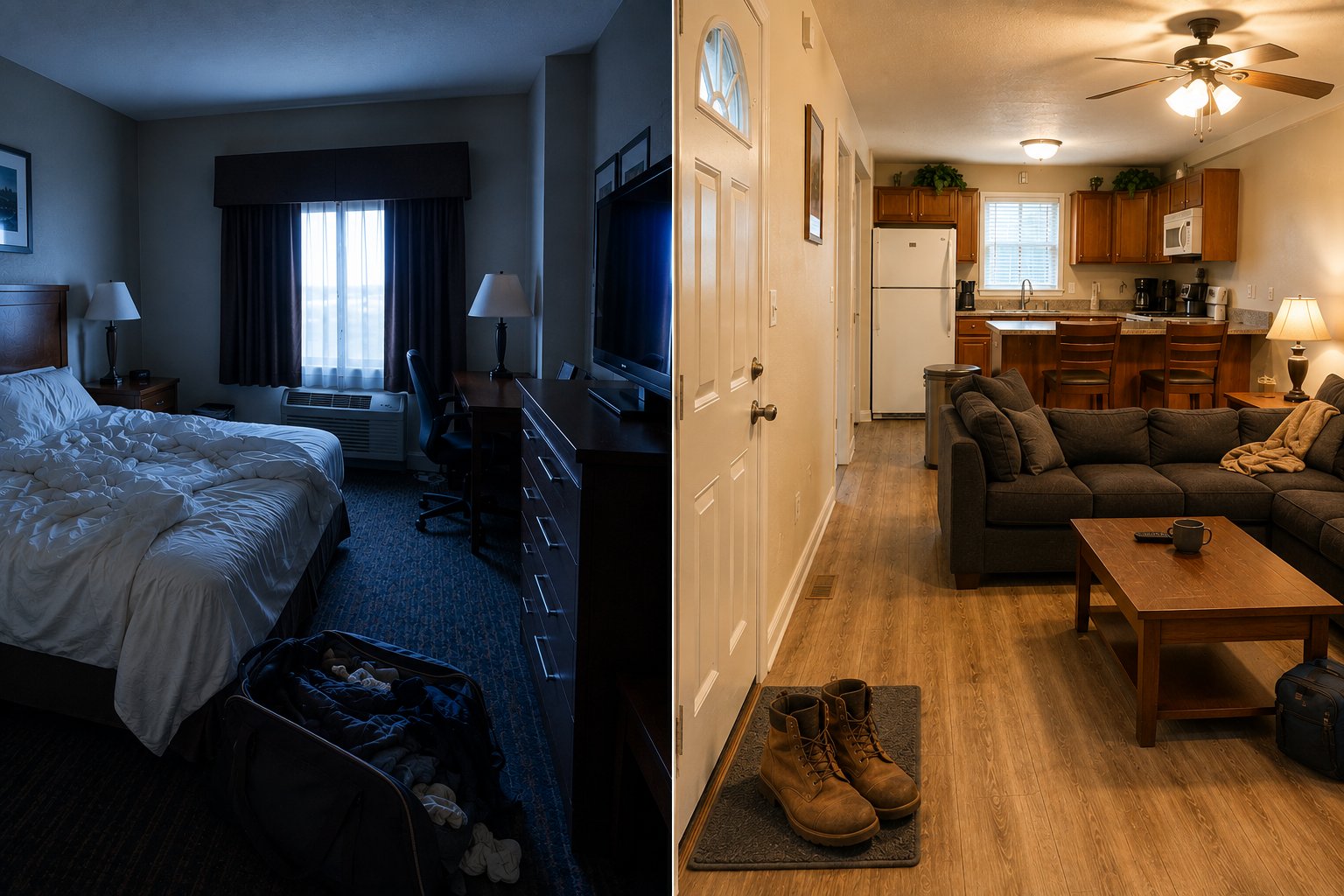
A real bed in a real bedroom. A kitchen with a stove, a refrigerator and enough counter space to actually cook. A living room with a couch. A driveway or parking area that is not a hotel lot. Laundry on site or nearby. Wi-Fi that is actually included.
Most furnished rentals near industrial job sites run $300 to $500 per week — sometimes less depending on the area and the property type. Compare that to a hotel at $80 to $150 per night and the math is obvious. A worker paying $400 per week for a furnished house is spending roughly $1,600 over four weeks. The same hotel at $100 per night runs $2,800 over the same period. That's $1,200 back in your pocket. Per month. Every month you're on that job.
For a six month assignment that's potentially $7,000 in savings — money that stays in your account instead of going to a hotel chain.
Beyond the money it's the quality of life. Workers who make the switch consistently say the same thing — they sleep better, eat better, feel better, and are less burned out by the end of a long assignment. When you have a real place to come home to, the job is more manageable. When you're living out of a suitcase in a hotel corridor, everything is harder.
"I Wish I'd Known You Were Here"
Here is the frustrating part of this story.
The furnished rentals exist. Landlords near refineries, pipelines, petrochemical plants, shipyards and major construction projects have been renting to industrial workers for years. Houses, cabins, garage apartments, mobile homes, private rooms, RV spots — all of it exists, all of it is available, and most of it is significantly cheaper than the local hotels.
The problem is that workers don't know about it.
There is no central place to look. No directory built specifically for this audience. Workers end up on Craigslist, sorting through hundreds of unrelated listings trying to find something near the job site. Or they ask around on the job — word of mouth, the old fashioned way. Or they spend the first month in a hotel while they figure out the area, and by then they're settled enough that it doesn't feel worth moving.
We've heard the same story more times than we can count — a worker who spent months in a hotel, then stumbled across a furnished house half a mile from the gate, and said the same thing every time:
"I wish I'd known you were here. I'd have been here from day one."
That's why BlueCollarHousing.com exists.
For Landlords — Here's What You're Missing
If you own property near an industrial job site — a refinery, a plant, a pipeline corridor, a shipyard, a data center construction project, a nuclear facility — and you're not renting to traveling workers, you are leaving money on the table.
Industrial workers are not your average renters. On most job sites they are drug tested before they ever walk through the gate. Many carry TWIC cards — federal credentials that require a background check to obtain. They earn good money plus a daily per diem. They pay on time, most prefer to pay weekly, and in our experience the vast majority are respectful of the property and among the most hassle free tenants you will find.
They are also not high maintenance. They're not calling you at midnight over minor issues. They are not staging your property for Instagram. They want a clean, furnished place close to the job site where they can decompress after a long day. That's the entire requirement.
Your rental does not need to be perfect. It needs to be clean, furnished and close to the job. A worker who just drove eight hours to a new job site and starts at 6 AM tomorrow does not care about your countertops. He cares that the bed is comfortable, the shower works and the Wi-Fi is reliable.
The financial case is straightforward. A furnished rental at $400 per week is roughly $1,600 to $1,700 per month depending on how you structure it. A traditional twelve month lease on the same property might bring $900 to $1,200 per month in many industrial markets. The math strongly favors the industrial workforce tenant — more income, shorter vacancy cycles, and a tenant profile that in most cases causes significantly less wear and tear than a long term lease situation.
The Opportunity on Both Sides
BlueCollarHousing.com was built to close the gap between workers who need a real place to stay and landlords who have exactly what those workers are looking for.
Workers browse free. No account required, no booking fees, no middleman. Find a listing, call the landlord directly. That's it.
Landlords list their properties for $99 per year — less than three nights in the hotel their future tenant is currently staying in. No calendars to manage, no reservations to juggle, no platform taking a cut of every payment. Direct contact, direct relationship, direct payment.
If you are a traveling worker tired of hotel life — BlueCollarHousing.com is where to start looking.
If you are a landlord near an industrial corridor who has ever wondered whether your property could be working harder for you — the answer is almost certainly yes.
The workers are out there. The properties are out there. They just need a place to find each other.
That's exactly what we built.
BlueCollarHousing.com — Hotel alternatives for those working on the road. Browse furnished rentals near your job site or list your property today.